Your liability
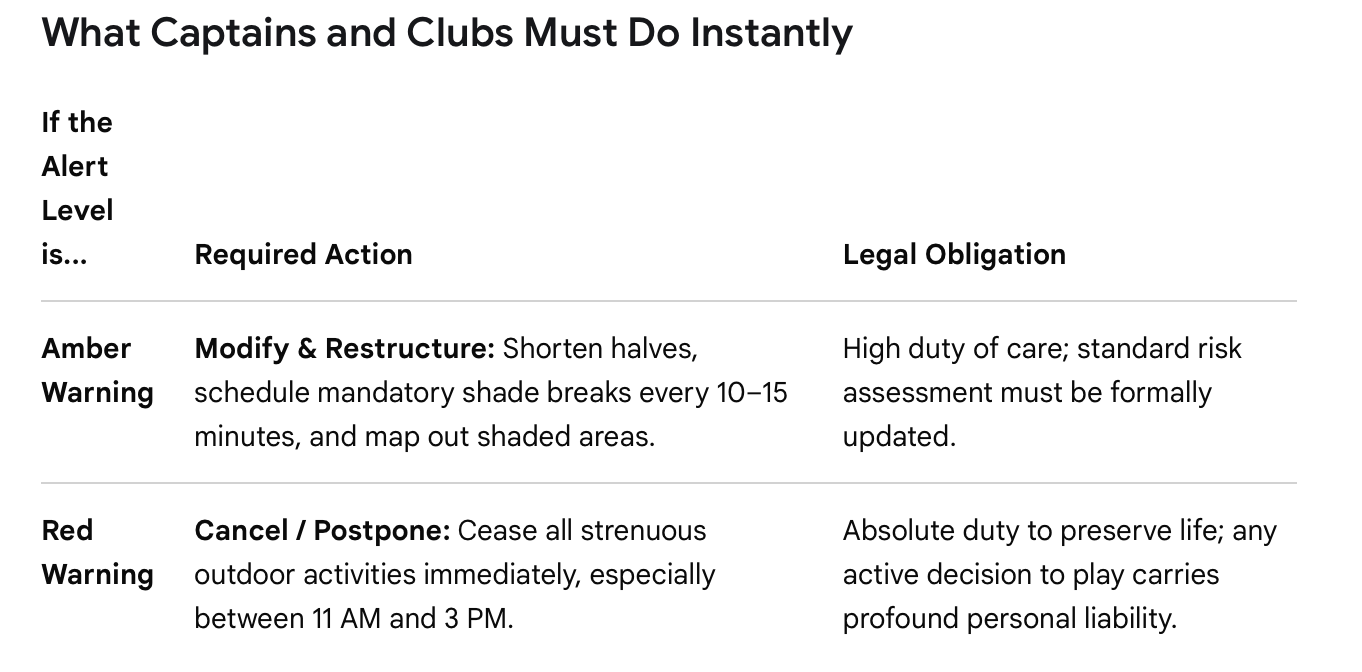
When a Red Extreme Heat Warning is issued, it indicates a potential risk to life and constitutes a national emergency. If team captains decide to bypass official safety warnings and proceed with a match, they, along with the club and governing league, face severe civil and potentially criminal liability for negligence and breach of duty of care.
Because a Red Alert establishes that the environment is inherently unsafe for strenuous physical exertion, proceeding creates massive legal and financial exposure.
1. Civil Liability and Negligence
To establish a personal injury claim, an injured party (player, official, or spectator) must prove that a duty of care was owed, that duty was breached, and the breach caused the injury.
The "Reasonable Person" Test: In a court of law, a captain's decision is measured against what a "reasonable team captain" would do. Ignoring an explicit, government-backed Red Weather Warning to play a voluntary game heavily fulfils the criteria for a breach of duty.
Gross Negligence: Proceeding despite a red-level warning—which explicitly signals danger to life—moves the behaviour from ordinary negligence to gross negligence. This can void standard liability insurance policies, which often feature exclusions for intentional reckless behaviour or defying government safety mandates.
2. The Myth of the Player Waiver (Volenti Non Fit Injuria)
Captains often believe that players "consent to the risk" by choosing to step onto the pitch. However:
Informed Consent is Voided: Players cannot fully consent to the hidden, escalating physiological dangers of exertional heatstroke.
Coercion and Peer Pressure: Junior players, trialists, or amateur athletes often feel immense pressure from captains to perform. Courts frequently rule that this power dynamic compromises a player's ability to truly exercise free will, transferring liability heavily onto the leadership.
3. Shared Liability: Clubs and Leagues
While the captain makes the on-field decision, the broader sports organisation shares the legal crosshairs:
Vicarious Liability: Clubs are legally responsible for the actions of their appointed captains during official activities. If the captain acts recklessly, the club's executives can be sued.
Failure to Provide a Safe Environment: If the venue lacks vast shaded areas, constant running water, or dedicated medical personnel equipped for thermal trauma, the club directly breaches basic occupiers' liability.
4. Criminal and Regulatory Consequences
If an athlete or spectator suffers severe organ failure or dies from exertional heat stroke (EHS) during the match, the consequences scale past financial payouts:
Corporate Manslaughter / Involuntary Manslaughter: Individual decision-makers (including captains and club chairs) can face criminal prosecution if their reckless disregard for a life-threatening alert directly causes a fatality.
Governing Body Sanctions: Most sports federations mandate that local clubs match or exceed national weather rules. Defying these can result in lifetime bans, club stripping, and heavy regulatory fines.
**************************************************